HOCD Symptoms: How Sexual Orientation OCD Can Feel and What to Do Next
HOCD symptoms can feel confusing because they often center on a question that matters deeply: "What if my sexual orientation is not what I thought?" For some people, normal curiosity about attraction feels calm, open, or even tender. For others, the same topic becomes sticky, frightening, and repetitive. If you are trying to understand the difference, a private sexuality self-reflection tool can be a gentle starting point, as long as you treat it as reflection rather than proof. This guide explains common HOCD symptoms, how they can differ from ordinary questioning, and what supportive next steps may look like.

What HOCD Means in Plain Language
HOCD is commonly used online to describe sexual orientation OCD, sometimes shortened to SO-OCD. It is not a separate identity label, and many clinicians prefer the broader term sexual orientation OCD because the fear can point in different directions. A straight person may fear being secretly gay. A gay person may fear being secretly straight. A bisexual, queer, or questioning person may fear they are "wrong" about their current understanding of themselves.
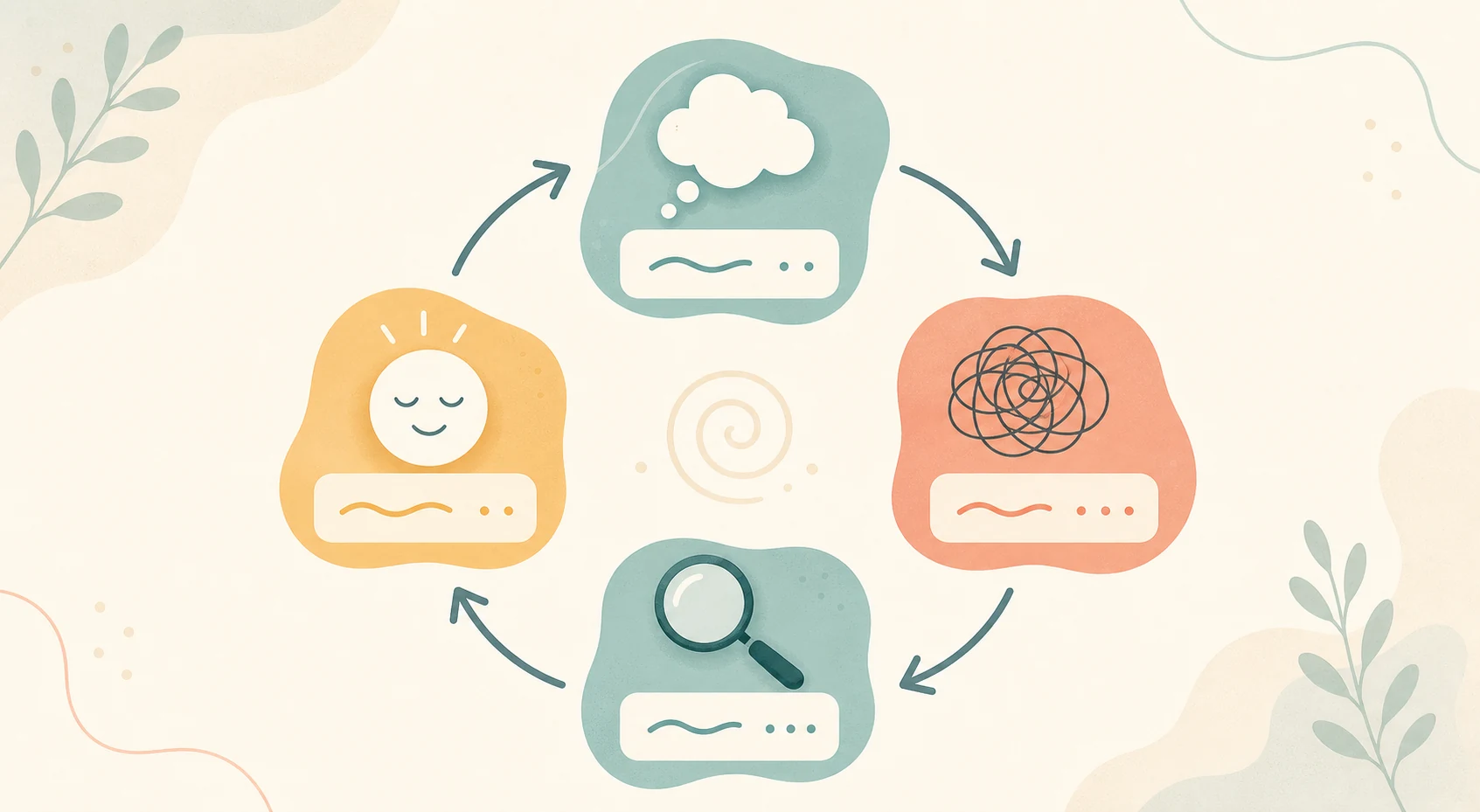
The key idea is not the specific orientation in the fear. The key idea is the OCD-like loop: an intrusive thought appears, anxiety spikes, and the person feels driven to check, compare, research, ask, avoid, or mentally review until they can feel certain. Relief may arrive for a few minutes, but the question tends to return.
That is why HOCD can be so hard to describe. The topic is sexual orientation, but the engine is often intolerance of uncertainty. The mind demands a final answer right now. When that answer does not feel certain enough, the loop begins again.
Common HOCD Symptoms and Thought Patterns
HOCD symptoms are usually a mix of intrusive thoughts, body checking, reassurance seeking, avoidance, and rumination. They can be subtle, especially when the compulsions happen mostly inside your head.
Common intrusive thoughts may include:
- "What if I am attracted to someone and did not notice before?"
- "What if my past relationships were not real?"
- "What if I am in denial?"
- "What if I never figure this out?"
- "What if one body sensation means everything?"
These thoughts often feel urgent, unwanted, and difficult to set aside. A person may spend hours replaying conversations, scanning memories, comparing attraction to different genders, or testing how they feel while looking at images or imagining scenarios. Someone searching for hocd thoughts examples is often trying to learn whether these thoughts are "normal." The more useful question is whether the thoughts are creating a repetitive fear-and-checking cycle that is interfering with daily life.
Compulsions can look like research, but the emotional tone is different from ordinary learning. You may read forum threads, watch videos, search hocd symptoms reddit, or compare strangers' stories to your own. You may ask friends or partners for reassurance, only to feel uncertain again later. You may avoid media, social settings, intimacy, certain friends, or LGBTQ+ spaces because you worry a reaction will "mean something."
If you are also exploring attraction in a broader way, a private orientation reflection experience may help you organize feelings without demanding one fixed answer. It should not be used as a reassurance ritual, though. If you notice yourself returning to any quiz or article over and over to reduce panic, that pattern itself is worth paying attention to.
HOCD or Denial: Why This Question Feels So Sticky
The phrase hocd or denial is popular because it names the fear directly. People want to know whether they are experiencing OCD-like doubt or avoiding a truth about their sexuality. Unfortunately, trying to force a perfect answer can become part of the loop.
Ordinary questioning often has room for curiosity. It may feel vulnerable, emotional, or uncertain, but it usually includes some sense of openness: "What do I notice? What feels meaningful? What kind of life feels honest to me?" HOCD-style doubt often feels more like an emergency: "I must know immediately, and if I cannot know, something terrible will happen."
Another difference is how reassurance behaves. In ordinary self-discovery, supportive information can help you reflect and gradually understand yourself. In an OCD-like cycle, reassurance tends to shrink anxiety briefly, then the mind asks for more evidence. A memory that felt clear yesterday may feel suspicious today. A physical sensation may be inspected until it feels loaded with meaning. A single passing thought may seem to cancel years of lived experience.
This does not mean you should ignore genuine attraction, identity questions, or a need for self-honesty. It means the method matters. If your approach is built around panic, checking, and certainty-seeking, it may be less likely to bring clarity. A steadier approach is to notice patterns over time, reduce compulsive checking where possible, and consider support from an OCD-informed mental health professional if the loop is causing distress.
What Causes HOCD Symptoms?
There is no single root cause that explains every person's HOCD symptoms. OCD-related patterns are often understood as a mix of biological vulnerability, learning history, stress, temperament, and the meanings a person attaches to certain thoughts. Sexual orientation can become a theme because identity, relationships, belonging, family expectations, faith, culture, and personal values can all feel deeply important.
For some people, symptoms intensify during adolescence or early adulthood, when attraction and identity are already developing. For others, the loop appears during a relationship, after a stressful life event, after seeing a triggering story online, or after a harmless thought that suddenly feels dangerous.
Stigma can also complicate the picture. A person may fear what a change in identity would mean socially, spiritually, romantically, or culturally. At the same time, HOCD is not the same as being LGBTQ+ or questioning. LGBTQ+ identities are real and valid. Sexual orientation OCD is about a distressing certainty-seeking loop around orientation, and it can affect people of any orientation.
How HOCD Symptoms Affect Attraction, Relationships, and Daily Life
HOCD symptoms can make attraction feel like a problem to solve rather than an experience to notice. A person may monitor whether they feel enough attraction to a partner, whether they feel too much attraction to someone else, or whether their body reacted in the "wrong" way. This monitoring can reduce natural desire, which then becomes new evidence for the fear.
Relationships may become strained when reassurance seeking increases. A partner may be asked the same question many times: "Do you think I seem different?" "Are we okay?" "Would I know if I were gay, straight, or bi?" The person asking may feel ashamed, while the partner may feel confused or helpless.
Daily life can shrink, too. Avoidance may start small: skipping a show, not going to the gym, muting certain social media accounts, or avoiding LGBTQ+ content. Over time, the world can begin to feel full of triggers. That narrowing is often more important than the content of any single thought.
A helpful self-check is not "Can I prove my orientation today?" but "Is my attempt to prove it making my life smaller?" If the answer is yes, that may be a signal to shift from certainty seeking toward support, skills, and values-based living.

What Helps: Treatment, Support, and Safer Self-Reflection
When people search hocd treatment or how to get rid of hocd permanently, they are often looking for relief from the loop. It makes sense to want the thoughts gone. But many OCD-informed approaches focus less on forcing thoughts away and more on changing the response to them.
Exposure and response prevention, often called ERP, is one evidence-informed approach used for OCD. In broad terms, ERP helps a person face triggers gradually while reducing compulsions such as checking, reassurance seeking, avoidance, or mental review. Cognitive behavioral therapy can also help people understand how thoughts, emotions, and behaviors interact. Some people discuss medication options with a qualified clinician, especially when symptoms are intense or broad.
Self-help can support professional care, but it should be gentle and realistic. You might try:
- Naming the loop: "This is an uncertainty spike, not an emergency."
- Delaying reassurance seeking for a short, planned period.
- Reducing repeated searches that leave you more anxious.
- Returning attention to a chosen activity without needing the thought to disappear first.
- Writing down values-based actions, such as being honest, kind, present, and connected.
If your distress is affecting sleep, relationships, school, work, sexuality, or safety, it is a good idea to speak with a licensed mental health professional who understands OCD and sexual orientation concerns. Educational articles can help you find language, but they cannot replace individualized care.

Using a Sexuality Quiz Without Feeding the HOCD Loop
Because gaytest.me is a reflection platform, it is important to be clear about healthy use. A quiz can help you slow down, organize attraction-related thoughts, and notice patterns in a private setting. It cannot settle every doubt, define your identity for you, or replace mental health support.
If you are in a calm, curious place, you can explore a private sexuality quiz as one piece of self-reflection. Before you begin, consider setting a boundary: one pass through the questions, no immediate repeating, and no using the result as a final verdict. Afterward, notice what the process brought up emotionally. Did it help you reflect, or did it become another attempt to neutralize anxiety?
If you are currently panicking, it may be kinder to pause. Ground yourself, step away from repeated checking, and return when you can approach the topic with more steadiness. Your identity does not need to be solved in one sitting.

Next Steps If HOCD Symptoms Feel Familiar
If HOCD symptoms feel familiar, begin with compassion. You are not strange for having intrusive thoughts, and you are not required to solve your entire identity under pressure. A more useful goal is to reduce the compulsive loop, make room for uncertainty, and reconnect with the parts of life that matter to you.
You might write down three columns: triggers, compulsions, and values. Triggers are the moments that spike fear. Compulsions are the things you do to feel certain. Values are the qualities you want to practice even when uncertainty is present. This simple map can help you see the pattern without turning it into another test.
You can also choose one small behavior to soften. Maybe you wait ten minutes before searching. Maybe you stop asking a partner the same reassurance question. Maybe you let a thought be present while you make dinner, answer a message, or take a walk. These are not quick fixes, but they can help you practice a different relationship with uncertainty.
If you want a calmer place to sort attraction-related questions without turning them into an emergency, an identity exploration tool can be one optional reflection aid. Use it slowly, and step away if you notice the urge to repeat it for certainty.
And if the loop is intense, persistent, or affecting your functioning, professional support matters. Look for a therapist who understands OCD, ERP, and sexuality-related intrusive thoughts. The right support should respect LGBTQ+ identities, avoid shame-based framing, and help you live more freely without promising absolute certainty.
FAQ
How can you tell if it is HOCD?
You cannot reliably settle this through one article or one moment of self-checking. A common clue is the cycle: intrusive orientation-related doubt, anxiety, checking or reassurance seeking, short relief, and then more doubt. If the pattern is repetitive and disruptive, consider speaking with an OCD-informed professional.
What is the root cause of HOCD?
There is usually no single root cause. OCD-related symptoms may involve genetic vulnerability, stress, learning history, temperament, and the personal meaning attached to intrusive thoughts. For some people, sexual orientation becomes the theme because identity and relationships feel especially important.
What can HOCD make you think?
HOCD can involve thoughts like "What if I am in denial?", "What if my relationship is not real?", "What if I reacted to that person?", or "What if I never know for sure?" The exact thought matters less than the repetitive fear, checking, avoidance, and need for certainty around it.
Is HOCD real?
Sexual orientation OCD is recognized by many OCD specialists as a common OCD theme, even if the exact term HOCD is not a standalone diagnosis in major manuals. The distress and compulsive patterns people describe can be very real and deserve informed support.
Is HOCD curable?
Many people learn to manage OCD symptoms well, and some experience major improvement. It is safer to think in terms of treatment, skills, and recovery rather than a permanent guarantee. ERP, CBT, and professional guidance can help many people reduce the impact of intrusive thoughts.
Are HOCD symptoms the same as questioning your sexuality?
No. Questioning your sexuality can be a normal, meaningful part of self-discovery. HOCD-like symptoms tend to feel more urgent, repetitive, and fear-driven, with a strong need to check or prove an answer. Some people may experience both identity exploration and OCD-like anxiety, which is why thoughtful support can be useful.
Should I use Reddit to understand HOCD symptoms?
Reddit can make people feel less alone, but repeated comparison can also become reassurance seeking. If reading threads leaves you calmer, wiser, and more grounded, it may be helpful in moderation. If it makes you check for hours or compare every detail, it may be feeding the loop.